Telehealt Application Mobile UI KIT: A Comprehensive Design System for Healthcare Mobile Apps
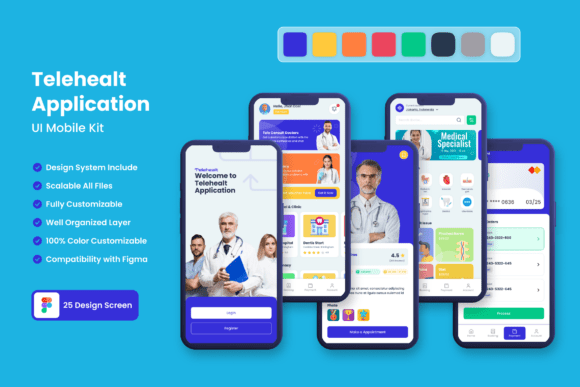
The landscape of mobile application development in healthcare has evolved rapidly, and designers and developers alike are constantly seeking efficient ways to create polished, user-friendly interfaces. A well-structured UI kit can serve as the backbone of a successful project, providing consistency, speed, and scalability. The Telehealt Application Mobile UI KIT offers exactly that: a complete design system comprising 25 high-quality templates purpose-built for mobile applications. Rather than starting from a blank canvas, you gain access to a library of ready-to-use screens that can be adapted to fit almost any healthcare or telehealth concept.
What Makes a UI Kit Indispensable for Mobile Application Design
Building a mobile application from scratch involves countless decisions about layout, typography, color schemes, and component behavior. A UI kit eliminates much of that guesswork by providing pre-designed elements that work together harmoniously. The Telehealt Application Mobile UI KIT goes a step further by offering 25 pixel-perfect screen designs that cover a wide range of common use cases. This means you are not just getting isolated buttons or icons; you are getting complete screens that demonstrate how different components should interact in a real application context.
For professionals working under tight deadlines, the ability to pull from a cohesive set of templates can reduce design iteration time significantly. Instead of spending hours aligning elements and testing responsiveness, you can focus on refining the user experience and tailoring the interface to your specific audience. The kit is built to be fully editable in Figma, which means every layer, every symbol, and every vector remains accessible and customizable.
Breaking Down the 25 High-Quality Templates
The core of any UI kit lies in the templates it includes. With 25 distinct screen designs, the Telehealt Application Mobile UI KIT provides a breadth of options that can address various stages of a user journey. These templates are not merely decorative mockups; they are functional layouts that reflect real interactions such as patient onboarding, appointment scheduling, medication tracking, health data visualization, and provider communication.
Each template is designed with pixel precision, ensuring that spacing, alignment, and visual hierarchy are maintained across different screen sizes. For a designer, this means less time troubleshooting alignment issues and more time experimenting with layout variations. The templates also serve as excellent starting points for brainstorming and user testing, as they allow stakeholders to visualize the application early in the development process.
Diversity of Screen Types
Among the 25 templates, you will find screens that cater to both patient-facing and provider-facing functionalities. Common screen types include login and registration flows, dashboard views, profile management, notification panels, and in-app messaging. This diversity allows you to mix and match templates to build a cohesive application without having to design each screen from scratch. The Telehealt Application Mobile UI KIT ensures that every screen feels part of a unified whole, which is critical for brand consistency and user trust.
The 80 UI Elements: Building Blocks for Customization
Beyond the templates, the kit includes 80 individual UI elements that act as the building blocks for any interface. These elements range from simple components like buttons, input fields, and toggles to more complex items such as cards, modals, and navigation bars. Having a rich library of UI elements means you can assemble custom screens by combining existing components in new ways.
For instance, you might take a dashboard template and replace a standard chart with a custom data visualization element from the library. Or you could combine elements from multiple templates to create a hybrid screen that better suits your unique workflow. The flexibility offered by 80 UI elements is particularly valuable for designers who need to iterate quickly without sacrificing quality.
Consistency Across Components
One of the most challenging aspects of mobile design is maintaining consistency across hundreds of screens and states. The Telehealt Application Mobile UI KIT addresses this by ensuring that every UI element adheres to a shared design language. Buttons have the same corner radius, input fields share the same padding, and typography follows a consistent scale. This level of consistency not only speeds up development but also improves usability, as users come to expect predictable interactions throughout the application.
100 Vector Layers and Symbol Objects: Depth in Design
Vector layers are what give a design its depth and detail. The kit includes 100 vector layers, allowing for intricate illustrations, icons, and background elements that can be scaled without losing quality. Vector graphics are resolution-independent, which is especially important for mobile applications that must function across devices with varying screen densities.
Symbol objects, another key feature, enable you to create reusable components that update globally. If you change a symbol instance in one place, that change propagates to every instance of the symbol across all your templates. This is a massive time-saver when you need to adjust colors, sizes, or styles late in the design process. The Telehealt Application Mobile UI KIT leverages Figma’s symbol system to provide a streamlined workflow that scales with your project.
Layered Organization for Easy Navigation
The kit is fully layered, which means every element is organized into logical groups and sub-groups within the Figma file. This organization makes it easy to locate specific components, isolate elements for editing, and hide layers that are not immediately needed. For teams collaborating on a single file, this layered structure reduces confusion and ensures that everyone can work efficiently without accidentally altering critical design elements.
Customization in Figma: A Flexible Workflow
Figma has become a go-to tool for collaborative design, and the Telehealt Application Mobile UI KIT is built specifically for this environment. Because the kit is fully editable, you can change text, swap colors, resize components, and rearrange layouts without encountering restrictions. This level of customization is essential when adapting a general template to a specific brand identity or user requirement.
The process of customizing a screen typically involves starting with one of the 25 templates, then adding or subtracting elements as needed. For example, you might remove a secondary navigation bar if your application uses a tab bar instead, or you might add additional data fields to a patient profile screen. The kit’s modular design encourages this kind of iterative refinement, allowing you to build exactly what you need without being locked into a rigid structure.
Easy to Change Color Style
Color plays a pivotal role in establishing brand identity and emotional tone. The Telehealt Application Mobile UI KIT makes color changes straightforward through Figma’s global styles and color variables. You can update the primary color, accent color, background shades, and text colors across all screens simultaneously. This capability is especially useful when creating multiple theme variations or when adapting the kit for different healthcare specialties, such as pediatrics, mental health, or chronic disease management.
Typography and Iconography: Free Resources That Save Time
The kit includes a free font, which eliminates the need to license a separate typeface for your project. Typography is a critical element of mobile design, affecting both readability and aesthetic appeal. With a pre-selected free font, you can maintain consistency without worrying about font licensing restrictions or compatibility issues.
In addition to the font, the kit provides free icon vectors that cover common healthcare and application-related icons. These icons are designed to match the overall style of the templates, so they integrate seamlessly from the start. The Telehealt Application Mobile UI KIT ensures that you have a complete visual language at your disposal, reducing the need to source external icon sets that may not align with your design direction.
Icon Vector Flexibility
Because the icons are provided as vectors, they can be resized, recolored, and combined without pixelation. This flexibility is important when you need to create custom icons for specific features or when you want to maintain visual consistency across different screen densities. The kit’s free icon vector library covers a broad range of categories, from navigation symbols to medical indicators, making it a practical resource for almost any healthcare application.
Scalability and Performance: 100% Scalable Vectors
Scalability is a term that gets used frequently in design discussions, but it carries real weight when you consider the diversity of mobile devices on the market. The Telehealt Application Mobile UI KIT is built entirely with scalable vectors, meaning that every element can be resized without degradation. This is particularly important for icons, illustrations, and graphical elements that need to look sharp on both small phone screens and larger tablets.
From a performance standpoint, vector-based designs also tend to result in smaller file sizes compared to raster-based alternatives. This can contribute to faster loading times and smoother interactions in the final application, especially when the UI is rendered natively. For developers who work closely with designers, having a vector-based kit simplifies asset export and ensures that what you see in Figma translates accurately to the final product.
Who Benefits from Using This UI Kit
The audience for a comprehensive UI kit like this is broader than one might initially assume. Designers, of course, are the primary beneficiaries, as they gain immediate access to a library of polished screens and components. But the kit also serves developers who need a reference for implementation, product managers who want to visualize features quickly, and even educators who teach mobile design principles using real-world examples.
For businesses and startups, the Telehealt Application Mobile UI KIT can reduce the time and cost associated with early-stage prototyping. Instead of hiring a design agency to produce initial mockups, an internal team can use the kit to create high-fidelity prototypes that are ready for user testing. Researchers and hobbyists exploring mobile health solutions also benefit from the kit’s comprehensive nature, as it provides a ready-made environment for experimenting with different design approaches.
Considerations for Effective Use
While the kit offers tremendous value, it is important to approach it with a clear understanding of your project’s specific needs. The templates are designed to be starting points, not final products. You should plan to invest time in customizing the screens to match your brand, your target audience, and the regulatory requirements that often accompany healthcare applications. Additionally, note that all images used in the preview are for demonstration purposes only and are not included in the download files. This means you will need to supply your own imagery or source placeholder assets as you build out your application.
Another consideration is the learning curve associated with Figma if you are new to the tool. However, the layered structure and symbol system used in the kit are designed to be intuitive, and Figma offers extensive documentation and community resources to help you get started. Once you are comfortable with the basics, customizing the Telehealt Application Mobile UI KIT becomes a straightforward process.
Practical Applications Across Healthcare Domains
The versatility of the kit makes it suitable for a wide range of healthcare applications. In telemedicine, for example, the onboarding and appointment scheduling templates can be adapted to connect patients with providers remotely. For health tracking apps, the dashboard and data visualization screens provide a foundation for displaying metrics such as step counts, heart rate, or medication adherence.
Mental health platforms can leverage the messaging and notification templates to facilitate secure communication between clients and therapists. Similarly, medication management apps can use the list and detail screens to help users track prescriptions and receive reminders. The Telehealt Application Mobile UI KIT provides enough structural diversity to support these varied use cases without forcing you into a single design paradigm.
Adapting to Different User Types
Healthcare applications often serve multiple user types, including patients, clinicians, administrators, and caregivers. Each user type requires a different interface with distinct information priorities. The kit’s 25 templates include options that cater to these different perspectives, allowing you to build separate flows for each role. By customizing the templates for each persona, you can create a more intuitive experience that reduces cognitive load and improves task efficiency.
Future-Proofing Your Design Workflow
Investing in a UI kit like this one is not just about solving immediate design challenges; it is also about building a workflow that can adapt as your project grows. Because the kit is fully editable and uses scalable vectors, you can continue to refine and expand your design library over time. New screens can be created by combining existing elements, and global style changes can be applied in minutes.
The Telehealt Application Mobile UI KIT serves as both a practical tool and a learning resource. By examining how the 80 UI elements and 25 templates are constructed, designers can gain insights into best practices for mobile healthcare design. This knowledge carries forward into future projects, whether they are built from scratch or with the help of another kit.
Integrating with Development Handoff
Figma’s collaboration features make it easy to share design files with developers for implementation. The kit’s organized layers and symbol system ensure that developers can inspect element properties accurately, reducing the back-and-forth that often plagues the handoff process. When every component is clearly labeled and grouped, the transition from design to code becomes smoother, and the likelihood of misinterpretation decreases.
For teams that use design systems extensively, the Telehealt Application Mobile UI KIT can be integrated into a larger component library or customized to become the foundation of an internal design system. Its modular structure makes it a strong candidate for long-term use, especially as your application evolves and requires new features or updated visual styles.
Getting the Most Out of the Kit
To maximize the value of the kit, start by reviewing all 25 templates to understand the range of screens available. Identify which templates align most closely with your application’s core functionality, and then begin customizing those screens first. As you work, take advantage of the symbol objects and global color styles to maintain consistency across your expanding design.
Experiment with adding or removing elements to see how the layout adapts. The 80 UI elements give you ample options for enrichment, but they also encourage restraint by providing only the components that are most commonly needed. This balance between completeness and focus is a hallmark of well-designed UI kits and is evident throughout the Telehealt Application Mobile UI KIT.
Finally, document the customizations you make so that other team members can understand the rationale behind design decisions. This practice not only improves collaboration but also makes future updates easier to implement.