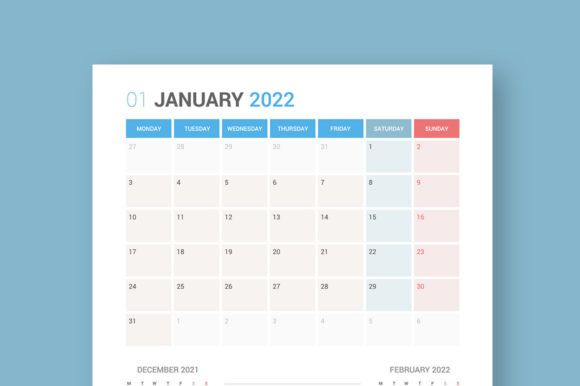
Monday Start Calendar 2022 Planner Design – A Complete Breakdown of Features and File Formats
When you are laying out a full year of schedules, project timelines, or personal milestones, the structure of your calendar planner matters just as much as the visual design. For 2022, the Calendar 2022 Planner Design Monday offers a thoughtful approach that centers on Monday as the weekly start, giving professionals, educators, and creative teams a practical way to organize time. Unlike Sunday-start calendars that can feel misaligned with work weeks and academic schedules, a Monday-oriented layout creates a natural flow from the start of the business week through the weekend closure. This article walks through the core characteristics of this planner design, covering everything from file specifications and month-by-month organization to real-world uses across different industries.
Why Monday Start Matters in Calendar Planning
Choosing a Monday start is not just a cosmetic preference. It reflects how millions of people actually experience their week. In most professional environments, Monday marks the beginning of meetings, deadlines, and project sprints. Schools and universities often schedule classes starting Monday. Even in personal life, many people plan their weeks from Monday through Sunday, treating the weekend as a cohesive ending rather than a fragmented break. The Calendar 2022 Planner Design Monday respects this natural rhythm.
The design places Monday in the leftmost column of the weekly grid, with Sunday closing the week at the far right. This arrangement makes it easier to visualize the full workweek at a glance, track deliverables from start to finish, and reserve the weekend for reflection or rest. For anyone managing editorial calendars, content schedules, or multi-phase projects, this layout reduces cognitive friction. You do not have to mentally reorder days or compensate for a Sunday start that feels out of step with your actual workflow.
Square Format and Large Canvas Dimensions
A notable feature of this planner is its square shape. Measuring 6250x6250 pixels and scaled to 53x53 centimeters, the design breaks away from traditional portrait or landscape calendars. The square format offers balanced negative space, making it equally suitable for wall displays, digital slideshows, and printed binders. The high resolution allows for crisp reproduction at large scale, and the even proportions lend themselves well to symmetrical layouts, circular annotations, or layered design elements.
At 53x53 cm, the physical print area is generous without being unwieldy. You can display it on a standard bulletin board, frame it for a studio wall, or insert it into a presentation without cropping or distortion. The pixel count ensures that even intricate monthly grids, small date numbers, and color-coded entries remain sharp whether you view the file on a 4K monitor or send it to a professional print shop. For designers who work across both digital and physical media, the consistency between pixel dimensions and centimeter measurements simplifies scaling decisions.
Twelve Separated Monthly Files with Contextual Previews
Rather than bundling the entire year into one unwieldy file, the Calendar 2022 Planner Design Monday delivers each month as its own individual file. This separation makes navigation faster and file management cleaner. You can open only the month you need, edit it independently, and share it with collaborators without exposing the full year. This is especially useful when working on quarterly budgets, seasonal content plans, or semester-based academic schedules.
Each monthly file includes the previous month and the following month displayed in a compact reference format. This contextual preview is a small but powerful feature. When you are planning the last week of January, you can see the first few days of February without switching files. When scheduling a multi-week campaign that bridges March and April, you do not have to toggle between documents. The adjacent month previews appear in a smaller, muted style so they do not distract from the focal month, but they remain fully legible for planning continuity.
This design approach mirrors how many people actually use a calendar. They do not think in isolated month-long blocks. They think in overlapping periods where one week's work naturally spills into the next month. Having the bordering months present in each file supports that seamless forward-thinking mindset.
The 21x21 Grid and Weekly Structure
Under the hood, the calendar follows a 21x21 grid system. This means 21 columns and 21 rows form the underlying framework for each monthly layout. The grid provides precise control over alignment, spacing, and proportional distribution of days. Because the week starts on Monday, the first column of the grid always begins with that day, and each subsequent column maps to Tuesday through Sunday.
The 21x21 structure is not arbitrary. It accommodates the maximum possible number of days in a month (31) while leaving room for the previous and next month previews, the month header, and annotation areas. The square cells created by the grid feel balanced and give each date a consistent amount of space. For users who print the calendar and write directly on it, the cell size is comfortable for handwritten notes, short reminders, or numerical data. For digital users, the grid makes it easy to snap text boxes, icons, or color blocks into precise positions.
File Formats and Editing Flexibility
One of the strongest aspects of this planner design is the range of file formats included. You receive AI, EPS, JPG, and SVG versions of each monthly file. This variety ensures that no matter which software environment you work in, you can open, customize, and export the calendar without compatibility issues.
AI (Adobe Illustrator) files are fully editable. Every text label, grid line, color swatch, and decorative element is composed of separate vector objects. You can change the font, resize the layout, replace the color palette to match your brand guidelines, or add your own graphic elements. The native AI format preserves all layers, so you can toggle visibility for different content layers, lock the grid while editing headers, or experiment with alternative color schemes without affecting the underlying structure.
EPS files provide a universal vector fallback. If you work in CorelDRAW, Affinity Designer, or an older version of Illustrator, the EPS format maintains the vector integrity of the design. This is important when collaborating across teams that use different software or when archiving files for long-term accessibility.
JPG files are ready for immediate use. They require no software to view, can be inserted directly into documents, attached to emails, or uploaded to websites. The high resolution ensures that even JPG compression does not degrade the fine details of the monthly grids.
SVG files offer a web-friendly vector format. If you are embedding the calendar into a web page, app interface, or interactive dashboard, SVG scales cleanly at any screen size. You can also edit SVG code programmatically to generate dynamic calendar versions, automate date overlays, or integrate with web-based scheduling tools.
Typography and the Roboto Family
The font used throughout the Calendar 2022 Planner Design Monday is Roboto, sourced from the Roboto family. Roboto is a versatile sans-serif typeface designed for high legibility across screens and print. In the context of a calendar planner, this means the day abbreviations, month names, and date numerals remain readable at small sizes inside the grid cells and prominent at larger sizes in headers.
Roboto offers multiple weights. The calendar likely uses regular or medium weight for standard date numerals, bold for month titles and day-of-week headers, and light for the adjacent month previews. This weight variation creates a clear visual hierarchy without relying on extra decorative elements. The typeface's friendly but professional character suits both corporate environments and creative studios. If you prefer a different font, the fully editable AI files let you swap Roboto for any other typeface in your library.
Practical Applications Across Use Cases
Different users will leverage this calendar design in different ways. Here are some common scenarios where the Monday start structure and the file feature set make a tangible difference.
Project management offices can use the calendar to map long-term milestones. Because each monthly file includes the neighboring months, it is easy to see how a project phase that starts in mid-March carries into early April. The square format fits neatly into printed handouts distributed during weekly stand-ups or monthly reviews.
Educational institutions benefit from the Monday start because academic calendars typically organize weeks around Monday class schedules. The 12 separate files let administrators distribute one month at a time to faculty, while the editable AI format allows them to insert school holidays, exam periods, and break weeks directly into the grid.
Freelancers and creative professionals often juggle multiple client deadlines. The large 53x53 cm canvas provides enough room to block out project phases in different colors, mark payment due dates, and track content deliverables. The SVG format is especially useful for freelancers who want to embed the calendar into a personal website or client portal.
Marketing and content teams plan editorial calendars around weekly publishing schedules. A Monday start aligns naturally with typical content release cycles. The JPG files can be used directly in slide decks, and the EPS files can be handed off to external agencies without worrying about version compatibility.
Common Considerations Before Choosing a Planner Design
When evaluating a calendar planner like this one, several factors come into play. File size matters when working with 6250x6250 pixel images across 12 months. Ensure your storage and transfer methods can handle files of this resolution, especially if you plan to store all months for the full year. The AI and EPS vector files will be smaller than the high-resolution JPG exports, but the JPG versions offer immediate convenience.
Editing proficiency also plays a role. While the AI files are fully editable, you need access to Adobe Illustrator or a compatible vector editor to customize them. If your team primarily uses presentation tools like PowerPoint or Google Slides, the JPG format is the safer choice. The SVG files bridge the gap for teams that work in web environments or modern document tools that support vector graphics.
Another point to consider is the level of customization you require. The font, colors, and grid structure are all adjustable in the editable files. However, if you plan to completely redesign the layout, you may want to start from the AI base files rather than trying to repurpose a JPG or SVG. The layered structure of the AI file gives you the most control over individual design elements.
Final Observations on the Design
The Calendar 2022 Planner Design Monday is not just a grid of dates. It is a carefully considered planning tool that respects how people actually organize their time. The Monday start reduces friction, the square format offers visual balance, and the inclusion of previous and next month previews supports continuous planning. The range of file formats ensures that the calendar can move seamlessly between design software, office documents, web platforms, and print production. Whether you are a solo professional managing your own schedule or a team coordinator aligning multiple workflows, this planner design provides the structure, flexibility, and clarity needed to stay organized throughout the year.